Principles
Rules eliminate judgment. Principles require it.
Principles are not rules. Rules eliminate judgment. Principles require it.
Most designers were taught a list. Never center body text. Never justify. Always use a grid. Limit the line length. Reduce the load. The list produces competent work and a quiet dependence, and almost no one is ever told what the list is for. The rules were the visible surface of something deeper, and the deeper part is where the actual thinking lives.
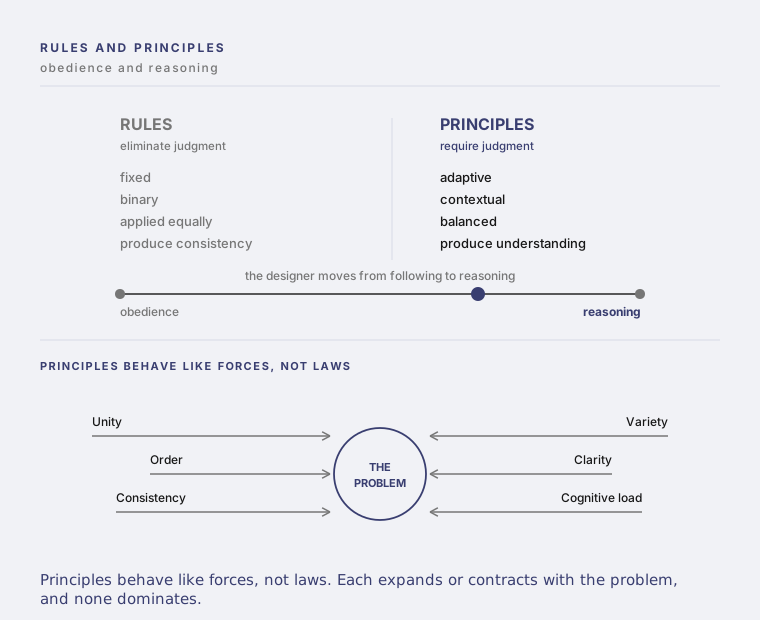
Rules eliminate judgment. Principles require it.
A rule and a principle can sound the same and could not be more different. A rule is fixed, binary and applied equally to every case. Its whole purpose is to remove judgment, so that an inexperienced hand still produces an acceptable result. A principle is the opposite. It is a force, not a command. It has a direction and a strength, it holds in some contexts and yields in others, and it cannot be applied without judgment, because judgment is the thing it asks for. Rules are followed. Principles are reasoned with.
Rules become crutches, then prisons.
This is the unintended cost of a rules-first education. The rules work, so the designer leans on them, and the leaning hardens into a habit of mind. Faced with a new problem, the trained question is no longer "what is this problem asking of me." It becomes "what rule applies here." That inversion is the quiet beginning of mediocre work. The rule was meant to be a floor. It became a ceiling.
A principle is a force, not a law.
Every principle has a strength and every principle has a limit, and every principle lives alongside others that can, in a given problem, outweigh it. Real work is almost never solved by maximizing one. It is solved by balancing several at once. Unity and variety. Order and surprise. Clarity and richness. Consistency and flexibility. Attention and load. Each of these expands or contracts depending on what the problem is asking, and reading that demand correctly is exactly the judgment a principle requires and a rule was built to avoid.
This is why frameworks exist.
Because principles never act alone, a thinking designer needs a way to hold several true principles in tension at once without dropping any of them. That is what a framework is. Not a larger rule, and not a replacement for principles, but a structured way of orchestrating them, so the balance can be reasoned about instead of guessed. The principles are the forces. The framework is how you conduct them.
The realization.
A designer who only knows rules is controlled by them. A designer who understands principles can change the shape of the problem itself. The rules were never the point. They were a beginner's compression of forces that, once understood, stop being constraints to obey and become instruments to think with.