Continuum Thinking
Reality rarely comes in two options. It comes in a range.
Most hard choices are presented as opposites. Almost none of them actually are.
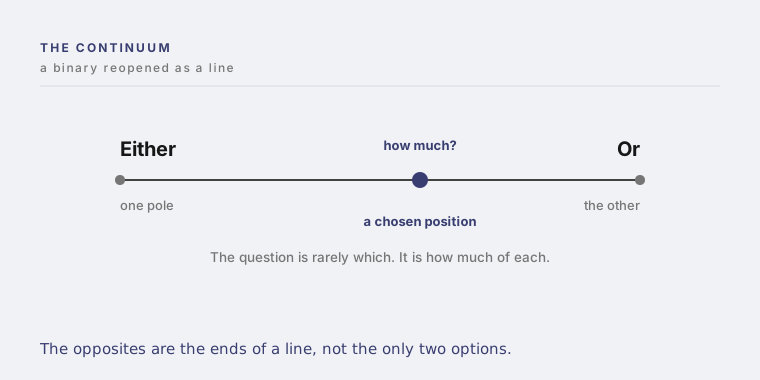
When a decision is framed as a choice between two things, it is usually being framed wrong. Order or chaos. Emotion or reason. Consistency or change. These are not categories you pick between. They are the two ends of a line, and the real question is where on the line to stand.
The principle
Between any two opposites lies a continuous spectrum. The opposites are the endpoints, not the options. Naming them reveals the axis, and once the axis is visible you can stand anywhere along it, and move deliberately as conditions change.
Why it matters
Binary framing does two kinds of damage. It hides the best answers, which usually sit somewhere along the line rather than at either pole. And it turns design decisions into fights: pick a side, defend it, win. A continuum turns the same decision back into a design. You are no longer joining a camp. You are choosing a position you can justify and adjust.
Mechanism
A binary asks which. A continuum asks how much. The shift is small and total. As soon as a choice becomes a dial instead of a switch, you gain three things at once: a range of options that did not exist before, a vocabulary for tradeoffs, and the ability to move without reversing yourself.
Applications
Order and chaos. Specific and general. Emotion and reason. Exploration and execution. Consistency and adaptation. Complexity and simplicity. Comfort and tension. Unity and variety. Each is a dial an organization is already turning, usually without admitting it.
Examples
A brand is not consistent or fresh. It chooses how much of each, and that ratio is its personality. A team is not structured or autonomous. A message is not emotional or rational. The teams and brands that feel confused are almost always the ones that never chose a position and are being pulled toward both ends at once.
The deepest version of this line runs from absolute sameness to absolute difference, boredom at one pole and chaos at the other. Almost everything that holds attention lives in the tension between them, which is why unity and variety is the continuum sitting underneath most of the others.
Questions for leaders
What false binary are we arguing about. What is the axis underneath it. Where on that axis do we actually want to stand, and why. What would move us along it, in either direction, on purpose.
Practical implications
When a debate hardens into two camps, stop arguing the sides and name the line between them. Most disagreements are not about which end is right. They are about a position no one has named yet.