Coherence
A customer meets one company. The company meets itself as departments.
A customer meets one company. The company meets itself as departments.
A customer never sees the org chart. They see one brand, one promise, one experience, assembled from whatever touchpoints they happen to cross. Inside, that same organization is a set of departments, each with its own goals, calendar and idea of the work. Coherence is the degree to which those two experiences agree.
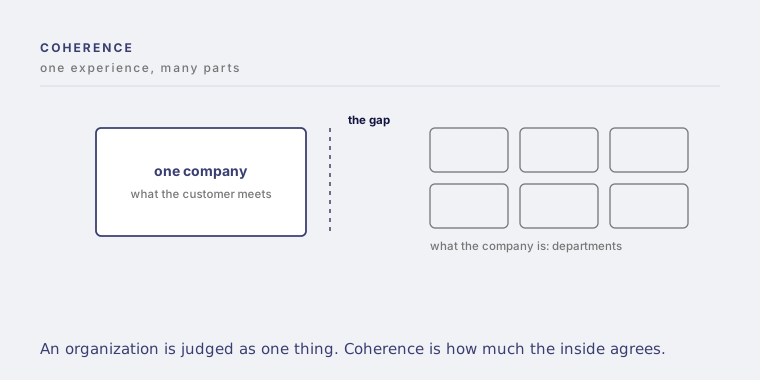
Coherence is hard because nothing in an organization naturally produces it. Each team optimizes its own piece, and every piece can be excellent while the whole feels like several companies wearing one logo. No one is rewarded for defending the seam between two departments, so the seams are exactly where coherence is lost. The force is not malice. It is specialization doing precisely what it was built to do.
Leaders miss it because every part passes its own review. The marketing is good, the product is good, the support is good, and the customer still feels handled by strangers who do not talk to each other.
Why it matters
An organization is judged as one thing whether or not it behaves as one. Incoherence is not cosmetic. It is felt as broken promises, because the part that made the promise is rarely the part that has to keep it. Over enough time the audience stops believing any single message, since experience keeps contradicting it. Coherence is not achieved once and filed away. It is stewarded, decision by decision, by someone willing to ask whether this choice reinforces the same intent as the last. The task is not to align the departments by force. It is to make one intention legible enough that a thousand local decisions point the same way without being told.