Derivative Thinking
Why most innovation isn't innovation.
Every mature category drifts toward sameness.
Innovation is celebrated in nearly every industry. Genuinely new ideas are surprisingly rare. Most of what gets called innovation isn't innovation at all. It's derivative thinking masquerading as originality.
A new feature. A new logo. A different color. A redesigned interface. A new pricing model. The surface changes while the assumptions underneath stay exactly where they were. The result isn't transformation. It's variation.
Derivative thinking isn't a sign of weak teams or dull people. It's the natural product of capable people optimizing inside a frame no one has examined. The work rewards it. Improving a known thing is legible, fundable and safe. Questioning the known thing is none of those, at least not until it pays off. So the incentives point at variation, and variation is what most markets get.
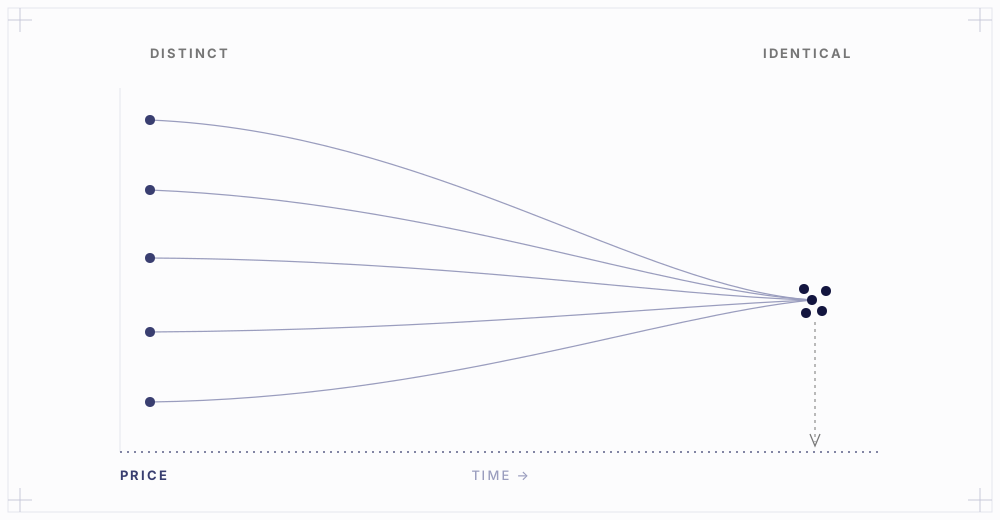
None of this looks like stagnation from the inside. Every release feels like progress, because something did change. But hold two competitors side by side across five years and the pattern shows itself. They've traded features, matched each other's language, arrived at the same page layouts and the same price tiers. They moved constantly and ended up in the same place.
Why this happens
Organizations rarely invent in isolation. They benchmark. They study competitors. They attend the same conferences, read the same analyst reports, hire from the same companies, and ask customers which features the other guys have. Every one of those inputs is reasonable. Together they pull in one direction.
A product manager compares the roadmap to the market leader's. A marketer studies the category's best-performing messaging. A designer opens a dozen competitor sites before sketching. A board asks how the plan stacks up against the comparables. Each decision is defensible on its own. Stacked on top of one another, they manufacture convergence.
This is the part worth slowing down on. Companies don't become similar because they copy each other. They become similar because they agree. They agree on who the customer is, what the product is for, how it should be sold, and what counts as table stakes. Copying is deliberate and rare. Agreement is invisible and constant, and it does far more damage.
Best practice is the polite name for the mechanism. A best practice is a decision that worked somewhere else, promoted to a rule that travels. Adopt enough of them and you've assembled a company out of other companies' answers. Case studies, playbooks and category reports all do the same job. They take one organization's context-bound choice and hand it to the whole category as the default, and defaults are invisible until someone thinks to question them.
Companies don't become similar because they copy each other. They become similar because they agree.
You can watch it in any mature category. Airlines settled on the same fare structure, the same boarding sequence and the same account of what flying is for, then spent a decade competing on baggage fees. Retail banks offer near-identical checking accounts and separate themselves with sign-up bonuses. A generation of direct-to-consumer brands adopted the same founder story, the same geometric wordmark, the same soft palette and the same line about cutting out the middleman, until they became visually interchangeable. Project trackers, CRMs and analytics dashboards have converged on a single idea of what business software looks like, down to the left-hand nav and the empty-state illustration.
No one in those rooms set out to build a copy. Each team believed it was improving. What none of them examined was the shared model of the category they were all improving within.
Agreement becomes gravity
Agreement doesn't stay neutral. Over time it hardens into something with its own pull. Once an industry treats a set of assumptions as the way things are, those assumptions stop being decisions and become the ground everyone stands on. Innovation keeps happening, but it happens in orbit. It circles the assumptions instead of questioning them.
That pull has a name. Category gravity is the force a mature category exerts on everyone inside it, drawing each new entrant toward the shape of the category itself. It's the reason a challenger so often ends up looking like a slightly cheaper version of the incumbent it set out to replace. It's a large enough idea to earn its own treatment, and it gets one next. For now it's enough to see that the sameness described here isn't the work of lazy teams. It's the expected result of many careful teams reasoning from the same starting point.
The commodity trap
Follow that pull far enough and a category reaches the same destination every time. The offerings look different and are fundamentally the same.
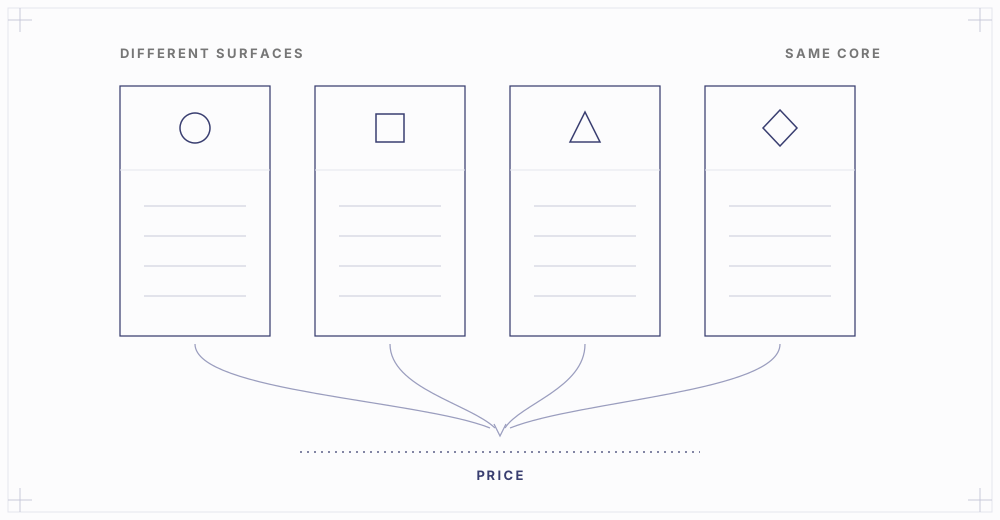
Different logos. Different messaging. Different features on the roadmap. Different pricing pages. Different launch videos. Underneath the surface, the same product solving the same problem for the same customer in the same way. The differences are real, and they're cosmetic, and cosmetic differences share one weakness. They're the easiest thing in the business to reproduce.
When one competitor ships a clever feature, the others match it within a quarter. When one lands a message that works, the phrase spreads across the category by the next campaign cycle. Surface differentiation has no defense, because anything that lives on the surface can be copied on the surface. Every advantage is temporary, every gap closes, and the distance between competitors keeps shrinking.
When the differences shrink far enough, the customer stops seeing a reason to prefer one option over another and falls back on the one variable that's always legible: price. This is the commodity trap. A weak economy didn't cause it and a ruthless competitor didn't cause it. The category produced it, as the accumulated interest on years of surface-level differentiation. Price competition is how a market punishes the sameness it agreed to.
Anything that lives on the surface can be copied on the surface. That is why cosmetic difference always ends in a price war.
The better question
Most organizations walk into that trap through the front door, carrying the wrong question. It's some version of this: how do we build a better version of what's already winning?
It sounds responsible. It also guarantees derivative answers. Start from what's already winning and everything you build is measured against it, shaped by it and finally in service of it. You can take the occasional feature and still lose the position, because you accepted the frame before you began. Optimizing an accepted assumption makes you better at a game someone else designed.
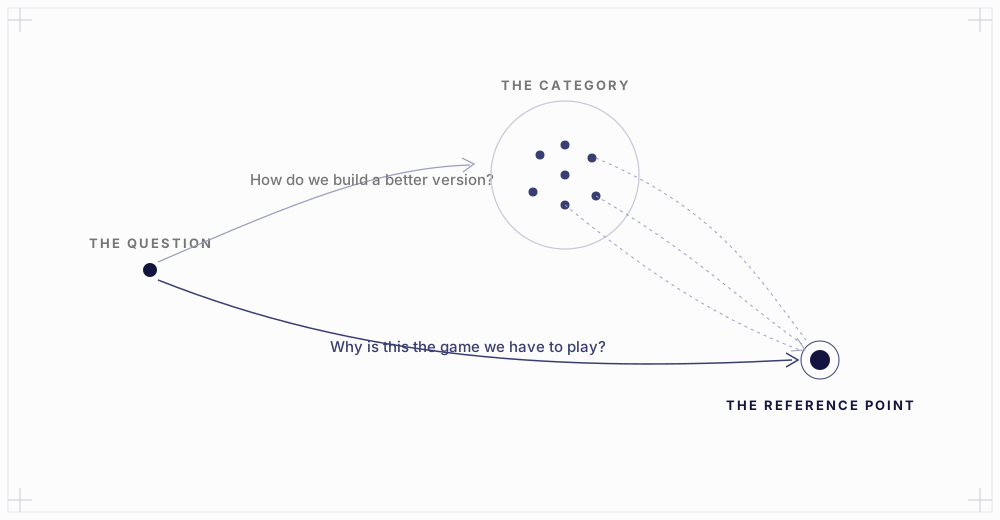
There's a different question, and it changes the size of the opportunity. Why does everyone believe this is the game we have to play?
That question treats the category's assumptions as choices rather than facts, which is what they are. Someone, at some point, decided who the customer was and what the product was for, and everyone since has inherited it. Ask why the assumption still holds and one of two things happens. Either you find a good reason, and now you understand your category more honestly than your competitors do. Or you find that the reason expired years ago and everyone kept believing it anyway. The second case is where genuinely new positions are found.
The move is easier to see in hindsight than to make in the moment. For years the assumption in mattresses was that no one would buy one without lying on it first, so the entire category organized itself around showrooms and commissioned salespeople. The assumption was true once. When it stopped being true, the companies that asked why it still held found an opening the incumbents had built their whole cost structure around defending. It looked like a fact right up until someone treated it as a question.
Optimizing an assumption competes for a share of a market that already exists. Questioning one can redraw the market's boundaries. The first is a fight over a fixed pie. The second changes what's on the table. That's why the returns are so lopsided, and why the same handful of companies keep getting called visionary. They weren't better at the category's game. They declined to play it.
From derivative to definitive
The aim of all this isn't to be different for its own sake. Difference is cheap and, as the commodity trap shows, temporary. The aim is to change the assumptions that define the category, so the position you take becomes the one others have to respond to. Three pieces of the work make the move concrete.
Victory questioned whether accountability software should be built primarily for people who are failing. The category assumed a product for struggle, framed around surveillance and relapse. Victory rejected that premise and treated the same software as a mark of who the customer was becoming rather than proof of what he couldn't stop. The assumption changed first. Everything visible followed from it.
Radiant questioned whether a wireless company had to compete as another telecom provider at all. The category's assumptions were coverage maps, plan grids and price per line. Radiant reframed the job as intentional digital living, a move from telecom to telecalm, and competed on something the incumbents weren't even measuring. Same industry, different game.
Frontline21 questioned whether Christian discipleship should mostly be about transferring information. The category had agreed, mostly without noticing, that discipleship meant content: more lessons, more study, more to know. Frontline21 treated the real work as formation rather than information, and that shift changed what the product was for before it changed how the product looked.
In each case the decisive move happened upstream of design, messaging and features. It happened at the level of the assumption. That's the line between a derivative move and a definitive one. A derivative move accepts the category's premise and competes inside it. A definitive move changes the premise, and the category has to reorganize around the change.
This isn't an argument for contrarianism. Breaking an assumption that's actually load-bearing just leaves you wrong in a new way. The discipline is to separate the conventions that earn trust from the ones that survive out of habit, keep the first, and spend your difference on the second. Most of a category is worth accepting. A few of its assumptions are worth everything, and those are usually the ones no one in the category can remember choosing.
Becoming the reference point
Categories don't change because someone executes better. Better execution is worth having, and it keeps you inside the existing frame, running the same race a length ahead. Categories change when someone changes what the category believes is possible. The assumptions move, and everything built on them has to move too.
When that happens, the competitors don't disappear. They do something more telling. They start responding to you. Your position becomes the thing they benchmark, the frame their strategy is drawn against, the standard their own customers now expect them to meet. The company that redefined the category becomes the reference point, and everyone else, admitted or not, becomes a derivative of the new idea.
There's a compounding advantage in the position, too. A reference point doesn't win once and defend the lead. It sets the terms new entrants are judged against, so the category keeps handing it relevance at no cost. Competitors spend their energy catching up to a place you've already left. That's a sturdier moat than any single feature, because it's built into how the category now thinks.
The goal isn't to be different. It's to become the reference point everyone else is measured against.
That's the whole distance the title is describing. Derivative to definitive. It's the difference between being one more careful improvement on an accepted idea and being the idea the next round of careful improvements is built on.
None of it starts with design. It starts with a refusal to treat the category's assumptions as facts, and a willingness to ask why everyone believes this is the game they have to play. Which leaves one question standing. How does a category hold those assumptions in place so firmly that capable, well-run organizations drift toward the middle without ever choosing to? That force has a name, and a mechanism of its own.