Cognitive Load
Effort is not the enemy. Unmanaged effort is.
The amount of effort a message demands is a variable you control, and the right amount is rarely the lowest.
The common advice is to reduce friction, simplify, lower the effort. It is half right. The effort a message demands is real and worth managing, but the goal is not always less of it. Cognitive load is a dial, and the lowest setting produces experiences no one remembers.
The principle
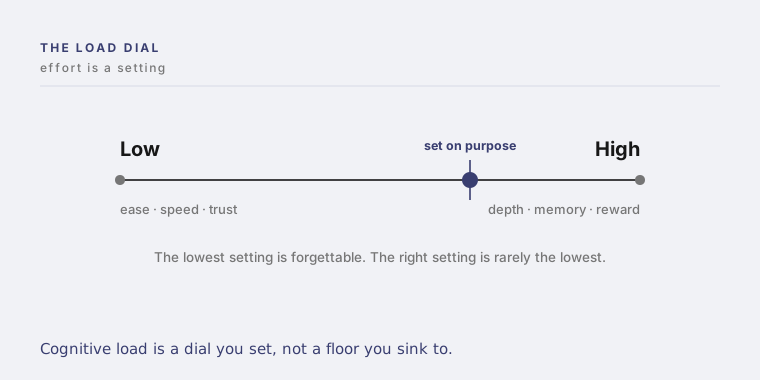
Cognitive load is something you set, not something you always minimize. Sometimes you reduce it, for clarity and trust. Sometimes you raise it, on purpose, to create curiosity, depth, discovery, reflection or delight. The skill is calibrating effort to the value waiting on the other side of it.
Mechanism
Low load gives ease, speed and trust. High load gives engagement, mystery, reward and memory. Effort that pays off becomes delight. Effort that does not becomes frustration. The same difficulty is a puzzle or an obstacle depending entirely on whether the reader gets something worth the work. The decision is never how to remove effort. It is whether this effort earns its keep.
There is a reason ease reads as trust. Taking something in costs real effort, and a mind that meets more difficulty than it expected treats the surplus as a signal to leave. That instinct is older than design, and it is why low load feels safe and why a confusing field gets abandoned before it is understood. The craft is knowing when to honor that instinct and when to override it on purpose.
The link to unity and variety
Cognitive load is the experiential reading of where you sit on the unity and variety line. Unity lowers load, because recognition is effortless. Variety raises it, because difference demands attention. Choosing how hard something is to take in is the same act as choosing how much sameness and difference it contains.
Applications
Interfaces reduce load at the checkout and can raise it in play. Brands keep a little mystery to build depth. Writing rewards a small amount of difficulty with a thought the reader would not have had if it were spelled out. Products, presentations and onboarding all spend or save effort, usually without admitting which.
Examples
A frictionless experience with nothing on the other side is forgettable. A demanding one that rewards the demand becomes the thing people remember and repeat. The most loved work is rarely the easiest. It is the work whose effort was clearly worth it.
Questions for leaders
Where are we making things so easy they are forgettable. Where is effort buying the reader something real, and where is it just cost. Are we minimizing load by reflex, when a little earned difficulty would create depth.
Practical implications
Decide, per moment, whether to spend effort or save it. Never default to the minimum. Reduce load where the value is speed and trust. Raise it where the value is curiosity, meaning and memory.