People pursue better versions of themselves
People don’t buy products. They pursue better versions of themselves. Every meaningful purchase has an emotional destination the reasons were built to reach.
People explain their purchases with reasons. Almost every meaningful one has an emotional destination the reasons were built to reach.
Ask why someone bought a thing and you will get a rational answer: the features, the price, the timing. The answer is usually true and almost never complete. Underneath the reasons sits a quieter motive, the person someone is trying to become. Products earn a place in a life less by what they do than by who they let a person be. This is the deepest lens I evaluate brands through, and it is why the strongest branding begins with understanding people rather than products.
Every purchase is an identity decision.
Most buying is not the pursuit of utility. It is the pursuit of self. A person reaches for the thing that confirms the identity he is trying to inhabit, and pays a premium for the confirmation.
Nike does not sell shoes so much as the identity of an athlete. Apple sells the feeling of being creative and discerning. Harley-Davidson sells freedom and membership in a tribe. Patagonia sells being the kind of person who protects wild places. Yeti sells rugged competence. In each case the product works, but the product is not the reason it is carried. It is carried because it says something true, or aspired to, about the person carrying it. The logo becomes a costume someone is willing to wear in public.
The ladder of human motivation.
Beneath behavior sit motivations, and they are not all at the same altitude. Some are low and urgent: fear, protection, security, survival. Some are high and slow: belonging, validation, mastery, purpose, identity, the reach toward a fuller self. Brands do not choose whether to sit on this ladder. They choose only where.
None of these motivations is wrong. But altitude has consequences. A brand anchored in fear has to keep the customer afraid in order to keep him at all. A brand anchored in who a person is becoming has room to grow as the person grows. The lower rungs win attention quickly. The higher rungs are what deepen over time.
People rarely buy what they need. They buy their way toward who they hope to be.
Tom Walker’s Primal Desires Framework gave me one of the clearest models for the deeper motivations that shape behavior. I have included it here as a primary source rather than paraphrased.
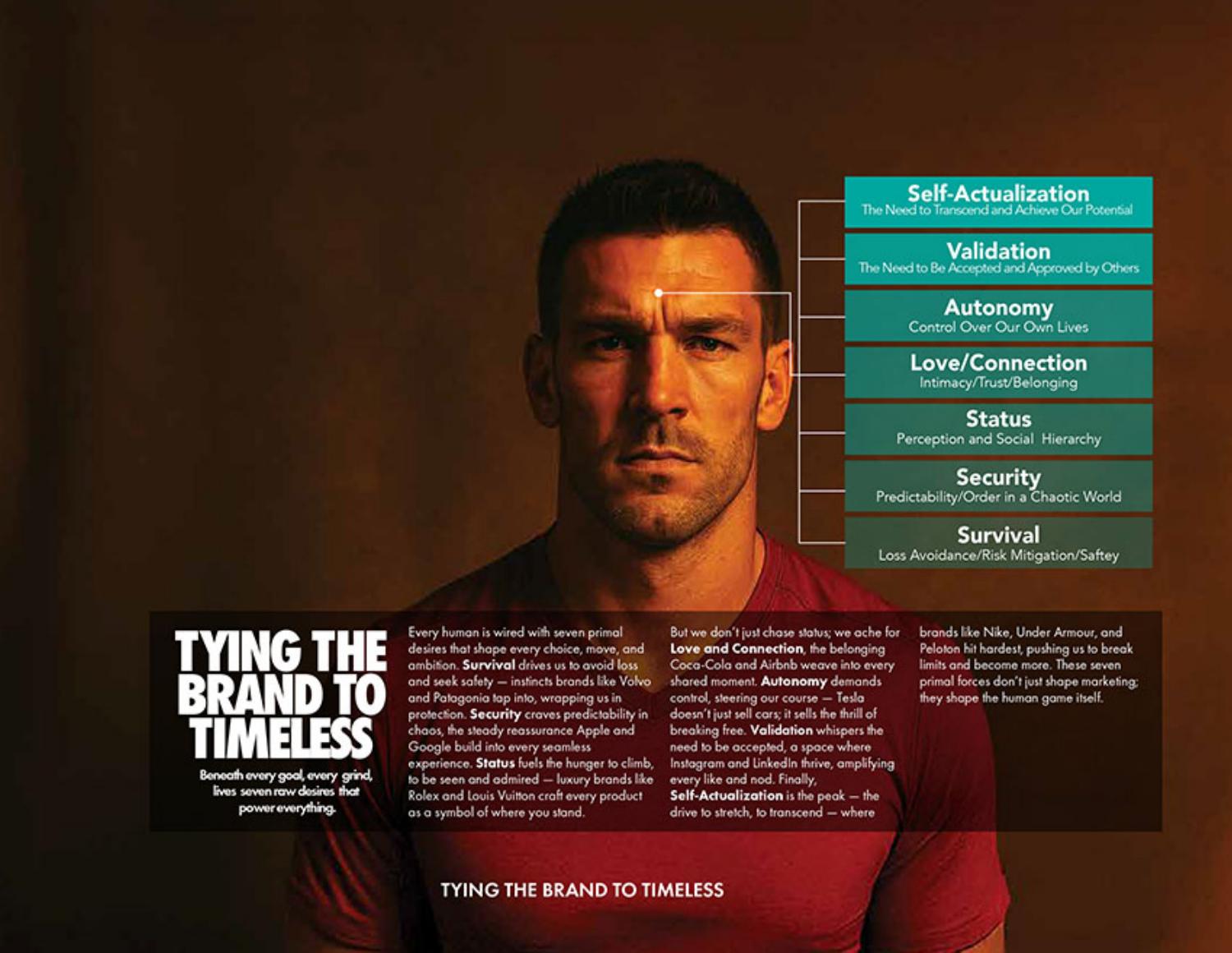
Designing brands people fall in love with.
Strategy changes the moment the question changes. Most teams ask, what problem are we solving. The stronger question is, what future is this person pursuing. The first points at the product. The second points at the person, and the person is where loyalty lives.
When the second question governs, everything downstream reorganizes around a desired identity rather than a solved annoyance. Messaging, product design, onboarding, the customer experience, the visual identity, the language, the community, the loyalty of it all. Each stops being a way to remove a pain and becomes a way to reinforce who the customer is trying to be. The product still solves the problem. It simply does so in the service of a self.
Why fear eventually loses.
Fear is an efficient way to get attention and a poor way to keep it. It can start a relationship. It cannot sustain one, because it asks the customer to remain in the emotion he is most desperate to leave.
A brand built entirely on anxiety needs its customer anxious. The day he feels safe, the reason to stay evaporates. A brand built on aspiration has the opposite condition, which is barely a problem at all: it grows more relevant as the customer grows. That is why some brands create lifelong advocates and others create temporary users. One depends on a feeling people flee. The other depends on a feeling people chase.
Fear can win attention. Only aspiration earns affection.
Victory as one application.
Victory is one place I watched this hold. The recovery category had built itself on the lowest rungs: fear, shame, surveillance, the daily reminder of failure. It worked well enough to acquire customers and poorly enough to keep them.
The move was not a new feature. It was a change of altitude. Instead of continually reinforcing pornography, shame and being watched, Victory invited a man toward courage, formation, identity and flourishing. The product changed very little. The relationship changed completely. The full application is in the Victory case study.
People rarely become loyal to products. They become loyal to the identities those products help them inhabit.
The strongest brands are not remembered for the problems they solved, but for the better self they helped someone imagine, and then inhabit.